Academy
Career
Contact
16 JULY 26

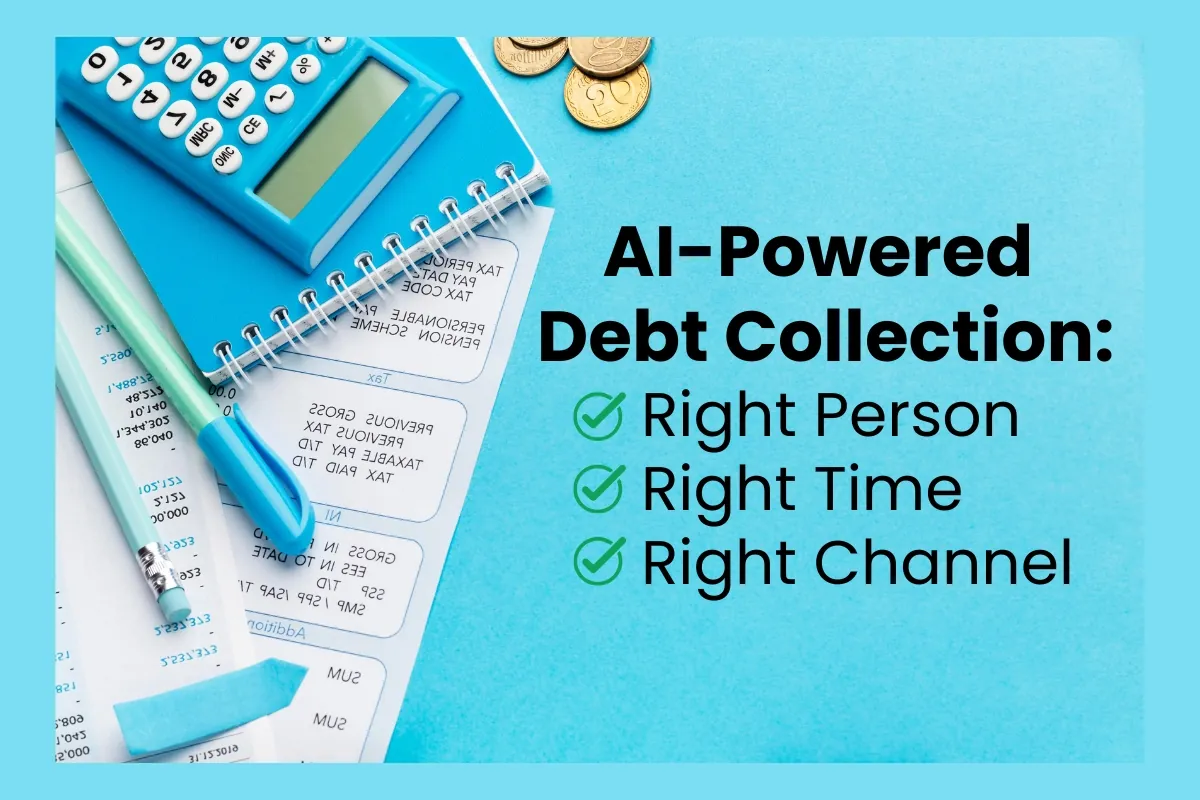
AI Debt Collection: Right Person, Right Time, Right Channel

Most collection teams still contact every debtor on the list without prioritisation. AI Debt Collection changes this by analysing which accounts to focus on, when to reach out, and which channel works best — improving recovery rates without increasing team size.
AI Debt Collection — ระบบติดตามหนี้ด้วย AI สำหรับสถาบันการเงินไทย

AI Debt Collection

Most collection teams still call every debtor on the list without prioritisation. AI Debt Collection changes this approach — analysing who to contact, when, and through which channel — to increase recovery rates without adding headcount. AI Debt Collection is a tool that helps collection teams focus on accounts with genuine recovery potential, at the right time, and through the most effective channel.

The Challenge Facing Collection Teams

AI Debt Collection is changing how collection teams work. Every day, teams with limited headcount face tens of thousands of overdue accounts. Traditional systems can't accurately segment or prioritise debtors, so teams waste time on accounts that will self-cure or accounts that simply can't be reached — while high-risk accounts with genuine recovery potential get overlooked. The lack of data insight for prioritisation leads to higher operational costs and disappointingly lower recovery rates.

Calling down a list in order is no different from spreading an organisation's best people evenly across every account — both the ones with almost no chance of payment and the ones the debtor was going to pay anyway. This is where AI Debt Collection changes the equation — not by calling faster, but by telling the team from the start where their limited time and headcount should go first.

AI Debt Collection (AI-Driven Debt Collection) is technology that uses artificial intelligence to analyse behaviour, payment history, and risk levels for each debtor in real time — to reach the right person, at the right time, in the right way. It increases Recovery Rate and reduces Cost-to-Collect without expanding headcount. The system runs on a Modular Structure that's easy to configure, connects with Core Banking or existing lending systems immediately, and supports the full credit lifecycle from Loan Origination and Loan Management through to AMC Solutions.

Key Highlights

Precise prioritisation: Reduces wasted resources from calling down a random list, shifting effort toward accounts with the highest value and recovery potential.

From reactive to preventive: AI predicts NPL risk before an account actually becomes overdue, allowing proactive intervention.

Personalised Communication: Selects the channel and timing each debtor segment is most likely to respond to, meaningfully increasing recovery.

Modular & Low-Code Flexibility: Deploy only the modules you need and adjust business conditions yourself, without rebuilding existing IT infrastructure.

Why Debt Collection Is Harder Today Than Ever

The lending and debt management market is under significant pressure from both economic conditions and completely shifted consumer behaviour.

Accounts are growing faster than headcount: Rapidly expanding loan portfolios mean overdue accounts multiply, while collection teams remain limited — leaving agents unable to cover debtors thoroughly.

Debtor behaviour has changed: Modern consumers respond less to phone calls, but produce better outcomes through digital channels such as SMS, apps, or self-service channels. A one-size-fits-all strategy no longer works.

Reference: Bank of Thailand, Household Debt Statistics Q4/2025 — outstanding balance approximately THB 16.44 trillion, roughly 86.7% of GDP. See household debt data at bot.or.th, Household Debt section.

The Problem With Traditional Debt Collection, Compared to AI Debt Collection

Laying traditional debt collection processes alongside an AI-assisted system makes the difference clear across several dimensions — from how accounts are chosen to how quickly strategy can be adjusted.

AspectTraditional Debt CollectionAI Debt Collection
Account selectionCall every account in list orderPrioritise accounts by highest recovery potential
Contact timingCall during standard working hoursChoose timing based on each debtor’s behaviour
Contact channelSame channel for everyoneChoose the channel each group responds to best
Risk detectionDiscover problems after they’re overdueAlert in advance before an account has issues
ReportingDelayed, not real-timeReal-time portfolio visibility
Decision basisExperience and instinctData and AI-driven analysis
Strategy adjustmentWait for IT every time something changesTeams adjust conditions themselves via configuration

What actually changes isn't just call speed — it's knowing in advance which accounts deserve priority, before an agent even picks up the phone.

The Evolution of AI Debt Collection: Toward Predicting Bad Debt Before It Happens

Step 1: Analyze & Prioritize

The system processes payment history, account behaviour, and past response outcomes into a real-time Risk & Recovery Score. Agents know immediately which account to start with today.

Step 2: Automate Strategy

The system recommends the appropriate channel — SMS, phone, app, or letter — along with the optimal timing, before the agent makes contact. This removes guesswork and trial and error.

Step 3: Monitor & Optimize

Management tracks team performance, recovery rates, and portfolio overview through a dashboard, and can adjust strategy conditions immediately through configuration — without waiting in an IT queue.

Hidden Costs Many Organisations Overlook

Traditional collection budgeting tends to focus only on visible costs — agent salaries, phone costs, or system fees. But the larger cost is usually hidden elsewhere:

Opportunity Loss: High-potential accounts don't get contacted at the right moment.

Operational Inefficiency: Teams waste time on accounts that would self-cure anyway, or on unresponsive accounts no matter how hard they try.

Compliance Risk: Manual processes lacking a clear audit trail.

Every baht not recovered in time is a real cost that hits the organisation's bottom line — even if it never appears on any expense report line.

Measurable Business Outcomes

Once the system begins prioritising correctly and selecting the right channel from the start, results show up across multiple dimensions of the business — from operations through to executive decision-making.

Higher response rate, from contacting the right channel at the right time.

Lower cost per baht recovered, because resources are used more precisely.

Each agent manages a larger portfolio effectively, without expanding the team.

Management sees risk and cash flow in advance, adjusting strategy in step with events.

Organisations can choose individual modules or connect them with existing systems without replacing their entire infrastructure.

AI Debt Collection Results: Proven Business Outcomes at Enterprise Grade

While each organisation's challenges differ, AI and automation technology from regional developers like JurisTech have demonstrated concrete results in operational efficiency and business agility across multiple countries. For example: higher auto-judgement capability — a case study from AEON Credit Service (Malaysia) found the system achieved an auto-judgement ratio of up to 42% without relying on manual staff. Applied to the collections side, this kind of capability significantly reduces repetitive work for teams. The result came from full deployment of Digital Onboarding and a Loan Origination System (LOS 3.0), which automated the process from initial assessment, e-mandate, and e-signature through to scoring models.

Explainable AI: The Answer for the Responsible Lending Era

Under the Bank of Thailand's Responsible Lending framework, AI used in financial services must not be a "black box." TBN's AI Collection system is therefore built as Explainable AI (XAI) — capable of clearly explaining the reasoning behind decisions, tracing the source of data, and supporting regulatory review.

The Role of AI Debt Collection Alongside Collection Agents

Multi-Channel Alerts, AI empowers the team — it doesn't replace people. Roles are divided as follows:

AI handles: repetitive tasks, calculations, large-scale data analysis, and list segmentation.

Agents handle: negotiation in complex cases, judgement calls, and maintaining the customer relationship.

The result: the same team achieves higher productivity, without being overloaded.

Checklist: Assessing Organisational Readiness

Having seen how AI and people divide roles, the next step is assessing your own organisation before investing. These 5 questions offer a starting point:

What is your collection team's current response rate?

Which step is taking up the most agent time each day?

Has your organisation segmented debtors by risk scoring yet?

Is your data ready for AI processing?

Have clear KPIs and recovery targets been set?

Expert Tips From the TBN Team

Beyond the checklist above, the TBN team — experienced in deploying systems for multiple financial institutions — offers additional advice from real-world implementation:

Start with the module that solves your most urgent problem first, then expand gradually. You don't need to replace every system at once.

Data quality is the foundation. Organising your data before starting with AI produces significantly more accurate results.

Measure continuously and adjust strategy based on real outcomes — don't configure once and walk away.

Why TBN's System Deploys Quickly and With Low Risk

The "start module by module" advice above isn't just a project management technique — it's a principle built into the system's structure from the start, making real-world deployment lower risk than a full system replacement.

Modular Architecture: Start with only the modules you need, without a high-risk, time-consuming Big Bang replacement.

Industry Best Practices: The system comes with best-practice frameworks built specifically for lending and banking businesses, ready to apply immediately.

Configurable Low-Code Technology: Business teams adjust rules, logic, and workflow themselves through configuration, without waiting for new code.

Connected as One With the End-to-End Digital Lending Suite

The modular flexibility that enables fast deployment isn't limited to the debt collection system alone — it extends across the entire Lending Solutions ecosystem.

Loan Origination System (LOS): Application intake and credit assessment

Loan Management System (LMS): Contract and loan account management

Hire Purchase System: Hire purchase management

AI Debt Collection System: AI-driven debt collection

NPL & AMC Solutions: Non-performing loan and asset management

Each module operates independently and connects with an organisation's existing systems, allowing data from the approval stage to flow into the collection stage without re-entry.

Frequently Asked Questions

What size of organisation is the AI Collection system suited for?

It suits commercial banks, Non-Bank financial institutions, digital lending providers, and Asset Management Companies (AMCs) with enterprise-level loan portfolios.

Can it connect to existing Core Banking or legacy systems?

Yes. The system supports enterprise-grade integration standards and works with existing systems immediately.

How long does implementation take?

Significantly faster than building a new system from scratch. It's Modular, so you can start with a single module, adjust strategy yourself without waiting for IT, and connect to existing systems immediately without rebuilding IT infrastructure. The exact timeline depends on the scope of modules selected.

Will AI replace debt collection agents?

No. AI handles prioritisation and data analysis, while negotiation in complex cases and customer relationship management still require people. AI helps the team work with clearer purpose — it doesn't replace them.

Conclusion: Toward a New Era of Sustainable Debt Management

Effective debt collection today isn't about calling faster or more often — it's about managing the right person, the right time, the right way. AI Debt Collection helps the same team work with clearer focus, without adding headcount, so organisations manage resources more effectively and reach business goals more precisely and faster.

TBN Corporation is ready to consult and design a system suited to your loan portfolio and organisational processes. View TBN's End-to-End Lending Solution or contact the TBN team to discuss an approach suited to your organisation.

RECENT POSTS

AMC ไทย 86 แห่ง กำลังจัดการ NPL ในระบบการเงินไทย
31 Aug 26
Article

AMC Capacity Crisis: Thailand’s 86 Firms Can’t Clear NPL Fast Enough

Thailand's 86 AMCs can resolve roughly THB 100 billion in NPL per year, but existing NPL in the system totals around THB 1 trillion — meaning it would take 7-10 years to clear at current capacity. This article explains what an AMC is, why this matters, and how technology can accelerate the process.
Top
Mainmenu
Investor Relations
Academy
Career
Contact

We use cookies to improve the performance and user experience of our website. You can find more details at Privacy Policy

Privacy Preferences

You can choose your cookie settings by enabling or disabling each type of cookie as needed, except for essential cookies.

Accept All
Manage Consent Preferences
  • Strictly Necessary
    Always Active

    Strictly Necessary

  • Analytics & Performance

    Analytics & Performance
    Cookies Details

  • Marketing

    Marketing_&_Advertising
    Cookies Details

Save